
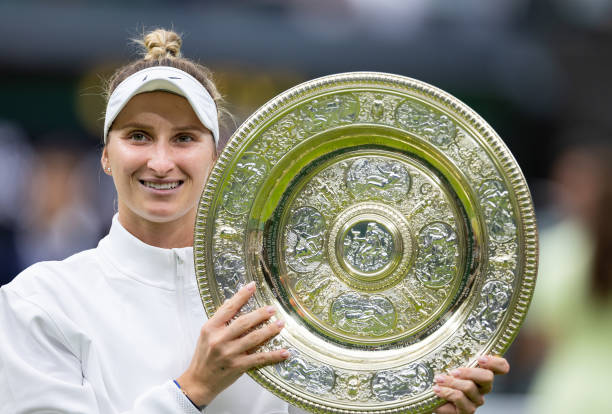
She was broken twice in a first set that twisted one way and suddenly the next. Then she spluttered a quartet of double-faults in set two, against a player who has seized upon smaller errors over the preceeding fortnight’s play. Yet Marketa Vondrousova played the bigger points smarter and stayed composed vs. Ons Jabeur, who has now lost consecutive Wimbledon finals. How did this happen?
Vondrousova confines Jabeur to more finals heartache
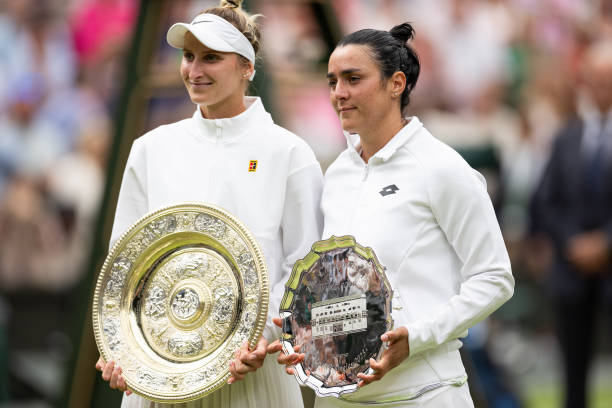
Vondrousova bt. Jabeur [6] 6-4, 6-4, clinches first Major title
- Vondrousova’s straight-sets win over Jabeur marked her first Major singles title in second Finals appearance, having lost the 2019 French Open final as a teenager vs. now-retired former world no. 1 Ashleigh Barty
- 24-year-old Czech became the first unseeded female player in history to win the Wimbledon trophy, at world #42 was second-lowest ranked finalist since WTA rankings formed in 1975 – Serena Williams (PR, 2018)
- Jabeur, after consecutive Wimbledon final defeats: “I think this is the most painful loss of my career, so… a tough day for me but I’m not gonna give up, come back stronger and win a Grand Slam one day. We’re gonna make it one day, I promise you. Tough journey but that’s tennis, I’ll win this.”
- After a magical fortnight, new world no. 10 Vondrousova says: “I don’t know what’s happening right now, an amazing feeling, Ons you’re such an inspiration for all of us – hope you win one day – I had a cast this time last year, it’s amazing I can stand here and hold this, tennis is crazy.”
Ons Jabeur led on three separate occasions during an 80-minute final that will probably hurt worse than last year’s three-set defeat by Elena Rybakina.
Rightly so, given the work she’s done both mentally and on court in returning to this point at a Major she hasn’t masked how badly she wants to finally conquer.
She served well enough in her first service game, then channelled aggression the right way to fashion a pair of break points in the very next frame as Vondrousova showed she was still finding her feet during their rally exchanges.
From 2-0 and 40-15 up, the Tunisian should’ve rode the momentum and extended that advantage – especially after a beautifully constructed point like this:
Loose forehands haunted her, Vondrousova gladly broke back after four deuces and you saw Jabeur berating herself after missing routine rally balls in the next game.
A byproduct of her high expectations and understandable given when they came, the 28-year-old’s repeated depth and ability to keep Vondrousova parked behind the baseline saw her create four more break point opportunities – all saved – before netting a backhand slice to end the match’s longest game with a whimper.
Four games in, both were hitting their stride as far as ball-striking rhythm was concerned and the longer rallies became commonplace.
This graphic showed how effective Jabeur had been, all tournament long, as far as winning points from a defensive situation – and soon enough she led 4-2 in a first set with more twists and turns to come.
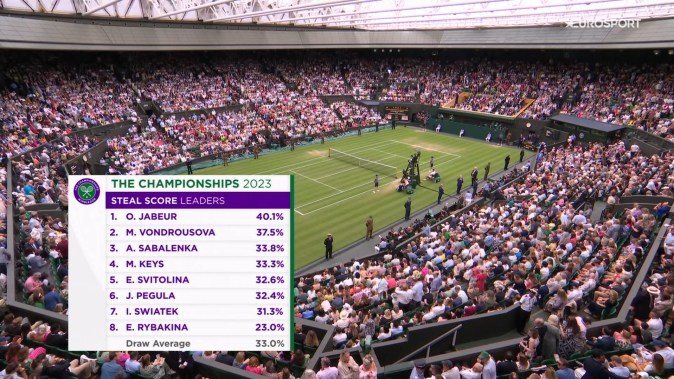
Slice returns, bringing the Czech to the net and forcing her to overthink in uncomfortable positions, Jabeur made establishing another break look easy. Then right on cue, so did Vondrousova.
Letting the former world no. 2 beat herself by spraying forehands long, giving her second serves to attack and this point, well, said all you needed to know:
An overhead miss at 4-4, 15-30 gave Vondrousova two break points and the 24-year-old’s relentless running saw her rewarded with another unforced error into the net from a three-time Grand Slam finalist who suddenly needed to recover from a set down for the fourth time in five matches if she was to win a first Major title.
That was after a love-hold by the Czech, no issues with nerves serving out the set, and this upcoming visual said all you needed to know.
Set two presented more chances, Jabeur couldn’t seize
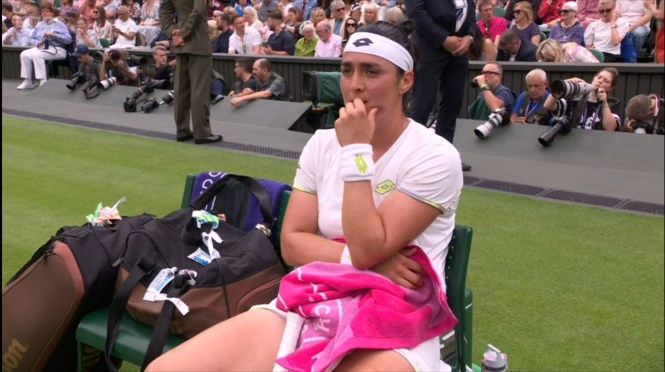
A set with 44% first serves in and 15 unforced errors wasn’t going to get the job done, as Jabeur’s player box – especially husband Karim Kamoun and coach Issam Jellali – looked deep in thought.
The Centre Court crowd felt compelled to get behind her earlier than they probably would’ve been expecting with their encouraging support, after a pair of loose points saw her staring down the barrel of a 0-30 deficit on serve to start the second.
They couldn’t play for her. This sequence happened and it seemed ominous:
Despite being down 40-0 at one point, Jabeur stayed composed and produced a fantastic point to break straight back at the second time of asking.
Composure was something she lacked though, having done well to go 3-1 up and then soon enough, it was level pegging once more.
Whether by design or not, her tendency to go for line-kissing winners only worked fleetingly and that aggressive intent quickly got stifled both by a counter-attacking opponent as well as herself: errors continuing to spill when she couldn’t afford many.
Vondrousova bided her time, waiting for an impatient moment during rallies or a chance to exploit space opening up, and soon earned a trio of championship points.
After double-faulting on the first, it felt fitting she’d finish the job at the net – having looked uncomfortable there at times – hitting an unreturnable half-volley before falling to the grass, soaking up the moment during an experience many didn’t expect her to reach, especially given her arduous road to recovery from two wrist surgeries.
Analysis, what’s next for both?
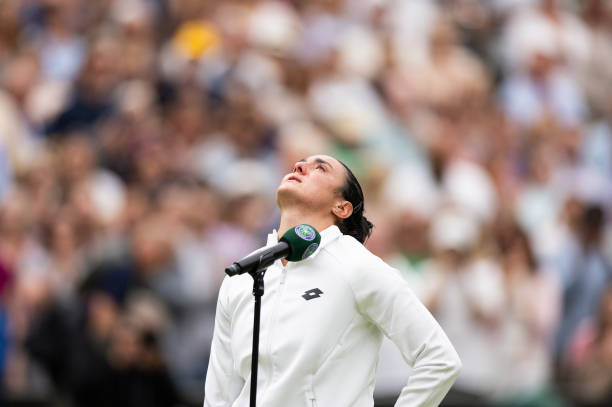
- Mats Wilander: “Jabeur looked like she went out to play a Wimbledon final, Vondrousova to play the seventh match of the tournament – such a big difference – didn’t capitalise on 2-0 or 4-2, then she went away after having chances in set two. All credit to the Czech for making it hell on the court.”
- Jabeur hit more than double Vondrousova’s winners (25-10), but also an alarming 31 unforced errors (Czech had 13) while recording less than 50% on first serve percentage and points won (48% on each category)
- Laura Robson: “She didn’t panic or overplay, waited for some errors to come and inevitably it’s going to happen. Ons tried to play too good, do everything and the discipline over the last few matches wasn’t there – had too many options and couldn’t stick to one. Marketa has all the same variety, hand skills, chill under pressure and knew when to use her variety.”
So another year, another painful defeat when it mattered most for Jabeur. She turns 29 in five weeks’ time and well, plenty has changed since I spoke about the need for perspective and positive reflection, after that agonising defeat by Rybakina.
At the time, I said:
When it comes to the biggest matches though, experiences like these should come in handy.
As time passes and more of these opportunities arise, Ons cannot afford for them to resemble scar tissue if she’s to achieve the big dreams she has, like the Rosewater Dish phone lockscreen she showed journalists as proof of just how much she wanted to win this year’s tournament.
The depth of women’s tennis continues to grow and there are a series of younger players – particularly a core group of Czechs like Vondrousova – who have been tipped to do big things in the coming years. Time’s ticking, as they bridge the gap.
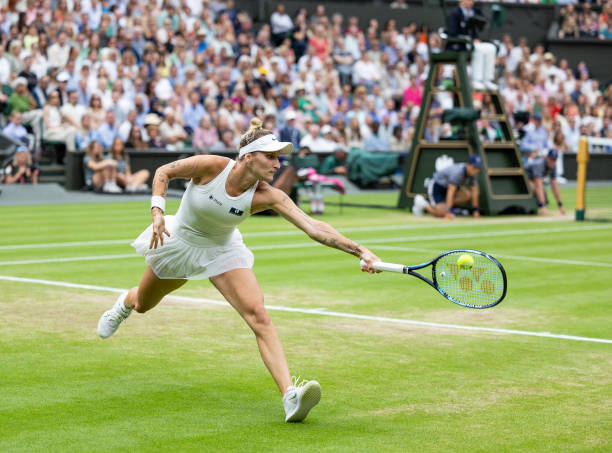
Vondrousova, much like Rybakina and Sabalenka before her, will now be given that championship-clinching morale boost she needs in more ways than one.
She’ll forever have Wimbledon champion next to her name, for one, as the pressure and expectation heightens on her shoulders during other events all-year round.
Just like her agemate, she’s now into the world’s top 10 rankings and will be a seed for the US Open (August 28 onwards), as she looks to build upon her best-ever finish at Flushing Meadows, a modest fourth-round berth in 2018.
Less than twelve months later, she was a Major finalist and while it’s taken some time to reach this stage, there’s still plenty of growth left in a self-assured 24-year-old wondering what’s next after an unforgettable fortnight. That’s the beauty of tennis.
Picture source: Getty Images, quotes via BBC TV and Eurosport broadcasts

 Mo and Sports